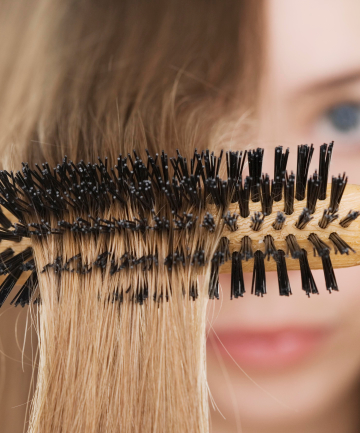
Doctors aren't exactly certain, but they suspect cortisol, the hormone secreted due to stress, has a lot to do with it. "If you're in a time of stress, your hair and nails are not considered to be vital organs," explains Dr. Engleman. This means that resources earmarked to grow nails and hair suddenly shift toward vital organs to keep you alive during perceived danger.
It's an old lizard brain function of the human body: when we used to have to outrun predators, growing long hair and nails isn't as important as, say, running for your life. The human body hasn't evolved with current technology: your brain can't discern between outrunning a sabre tooth tiger and answering emails from your boss, news coverage, or hours of social media. It's just doing what it does to keep you alive.
Image via Tetra Images/Getty
Photo 4/14
All types of stressful events can cause it, even "good" ones
But what they do know is that any perceived trauma to the body can cause hair to fall into telogen effluvium. "It can be physiologic or emotional stress, and it may not be due to a bad thing," says Dr. Gohara. "It could be something joyful, like a wedding, giving birth, or moving somewhere. Pregnancy can also be a physiologic stress on your body." But, as she explains, illness and negative life stress like divorce or loss of a job also kick it into gear. "It can be anything that poses some type of physiologic or emotional stress on you, from general anesthesia to having a really bad flu, stress related to COVID, or just the stress of living right now."
Image via Imaxtree
Photo 5/14
It's also not immediate
Here's the kicker: it takes time to grow hair, right? Which also means the resulting telogen effluvium you're experiencing is probably from something that happened three-to-nine months ago. "When you're pregnant, you've got great hair," explains Dr. Engleman. "Once we give birth, it can be three-to-nine months postpartum that hair starts to shed. "It's why patients with a nine-month-old child can't figure out why their hair is falling out. "It's a snapshot of what happened in the past." Which means a stressful event in the past could be causing the hair loss you have now.
Also, the amount shed is profound by the time you notice it. "The reality is, people often have to lose about 50 percent of their hair volume before they detect they're losing hair, which is a lot to lose," Dr. Engleman warns. "Patients often notice their ponytail isn't as thick; they're perceiving a significant reduction, which is real: a patient has to lose a lot (of hair) before they notice they've lost it."
But you aren't alone: both our dermatologists have seen a massive uptick in stress-related hair loss cases this year. "I've had more tears shed in my office over hair loss than even skin cancer because it really is so emotional for people," says Dr. Engleman, whose patients bring in bags of lost hair or photos depicting shower drains filled with it. "It's so psychologically stressful."
Dr. Gohara agrees the uptick in telogen effluvium patients is across the board "People are scared out of their minds," she observes, noting people will come in afraid to take showers and/or wash their hair for fear of their part getting wider.
Image via Luka Svetic/EyeEm/Getty
Photo 6/14
Take control of your health
Yes, your stress-related telogen effluvium will pass, but be aware hair loss could also be due to autoimmune triggers, genetic disposition, or other malfunctions of the body. This means it pays to have an official diagnosis from a dermatologist who can run tests and diagnose you accordingly. This isn't something you should self-diagnose: while telogen effluvium isn't a serious medical problem, other conditions which cause hair loss could be.
Image via SDI Productions/Getty
Photo 7/14
Get educated
Know stress-related hair loss, while disconcerting, isn't permanent. "First, we have to educate the patient," says Dr. Engleman. "You're going to stop the falling out and then you'll see new growth, but it takes a while. It's not fun because patients want an immediate result." Again, anyone who's ever tried to grow their hair out knows there's a waiting game. Dr. Engleman advises managing expectations appropriately: first, stop the shedding, then focus on regrowth. But time takes time, so be patient.